
When Little Red Riding Hood steps into the forest, we know she is entering a different world. Outside she could see for miles across a patchwork of fields and farms. But in the wild tangle, her view extends for only a few paces beyond the path. When sight is restricted other senses come alive. We listen. We sniff the air for scents. Wolves may be hiding in dark places. But also possibilities. The prospect is enticing and frightening in equal measure.

Entering the forest, we have crossed a boundary. In the fields, each crop and furrow were placed with logical purpose. But the complexity of the woods follows different rules – a web of relationships we may not be able to understand, but whose presence we will surely feel. Our reasoning minds cannot contain it, so emotions must take the lead.

Photo by Rod Duncan
This transition is mirrored in many stories – from a world understood to one where our old rules no longer suffice. It can even be a journey into the underworld, the realm of death (and hopefully out again). A similar boundary can be found in maps of the mind. On one side is the logic and accessibility of conscious thought. On the other side lies a churn of emotions and half-thought things. This is the subconscious, filled with possibility and danger.
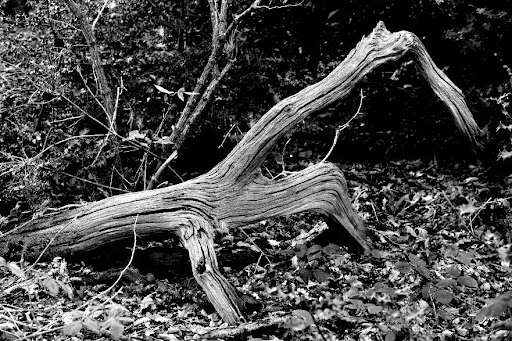
Photo by Rod Duncan
Each of these three arenas can stand as a metaphor for the others – the physical landscape, the world of story and myth, and psychoanalytic descriptions of the mind. They are three maps, perfectly superimposed. A walk in the forest may be simply a walk in the forest – with no metaphors attached. But it may also be a re-enactment of Red Riding Hood’s archetypal journey. And a pilgrimage to somewhere inside ourselves.

Photo by Rod Duncan
Rod’s Writing Walks podcasts can be freely streamed here.
 Space Cat Press