

Two weeks on, we are still looping around the glorious constellation that was the annual British National Science Fiction Convention. Our first ever Eastercon was everything you’d hope for – the welcoming friendly vibe, the costumes, the spellbinding art and crafts, the hubbub of fans and creatives, writers, readers, booksellers. The passion for storytelling and style. Eastercon 23 was themed Conversation and there was plenty of that going on in every corner, including the online Discord hub. I was really impressed with Eastercon’s commitment to providing a fully hybrid convention with digital social gatherings as well as live-streamed panels. Meanwhile, on the Hilton Metropole hotel site, the volunteers team had thought of everything from food trucks to quiet rooms to daily bulletins. We were like a self-contained spaceship spinning in our own giddy orbit for that mad Easter weekend.

SFF Magazines. Photo: Siobhan Logan
The programme of panels and readings was extraordinary, with dozens of activities running from dawn to dusk and well beyond. I staggered out of one session on ‘The Dark Heart of Childhood Fiction’ at 10pm. We might have yearned to clone ourselves. But, no need. Thanks to the excellent con-tech, I’ve been trawling through recorded sessions ever since. Many panels included online speakers, such as Oghenechovwe Ekepi speaking from Nigeria on Living Dystopia: Is the Real World Worse? Ekepi is author of a recent Uncanny magazine article on ‘Too Dystopian for Whom?’ (issue 48). He spoke of his experience of living through a real-life dystopia in Nigeria. There was much discussion of how you measure a slide into dystopia from air quality or prevalence of open defecation to erosion of human rights. On the value of dystopian fiction, Ekepi likened it to a mirror held up to society: ‘Sometimes we need a reflection of pain to explore how we interact with it.’ When the room’s audience was polled, interestingly 50% of people thought we are living through a dystopia right now.
Climate change is just one of the spiralling series of crises, local and global, we are contending with. In a panel on Climate Fiction, Ian Green spoke of ‘books as mini-empathy engines’, translating huge societal change down to an individual level. Several authors spoke of how activism might sit with writing or how imagination might be a vital intervention. I was reminded of how the early Space Race was only made possible by the storytelling of early sci-fi. It takes such a leap of vision to see how we might live beyond fossil-fuelled capitalism. Solarpunk sci-fi takes us right there, as celebrated by Francesco Verso, the Italian author of The Roamers, just out in translation with Flame Tree Press. He provided a fascinating survey on how ‘Solarpunk looks for exit strategies from the cyberpunk dystopia we’re living in’. Solarpunk assumes the ‘end of the world’ (as we know it) is already unfolding. It focuses on human adaptations to that apocalypse from nano-tech and 3-D printing to social re-wiring, from resilience to rebuilding. And it leans heavily into an anarchist-socialist vision that re-imagines how our communities might survive and eventually thrive in a sustainable way.
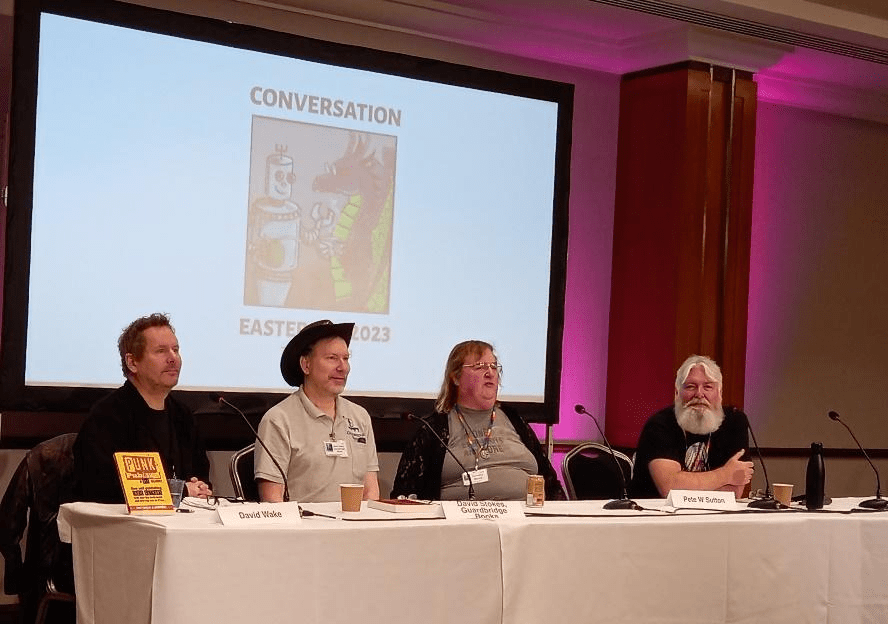
Photo: Siobhan Logan
Right-wing culture wars are another grim feature of our current dystopia, with people like trans-school student Brihanna Grey paying the price when rhetoric spills into violence. The gender-critical movement is actively seeking to ban trans people from public toilets or attacking Drag Queens as toxic to children. It rehashes the ‘all gays are predators’ narrative we endured in the 1980s. So I was heartened to see several panels focus on how SFF provides a unique space for LGBTQIA+ representation. Be Gay, Do Crime: Was Magneto Right? explored the long-term depiction of queer characters as villains as well as current attempts by various states to re-criminalise aspects of queer existence and expression. As Roz Kaveney said, ‘If your existence is a crime, then be a criminal.’ Certainly, contemporary SFF can allow LGBTQIA+ young people to see themselves represented positively in all our/ their complexity.
That SFF as a genre has come a long way was evident in the many book recommendations offered in No Simple Binaries and Radical Imaginings: LGBTQ+ Liberation panels. I was also reminded how vital small presses are to that project in Independent Treasures: Small Presses. Often they’re providing Own Voice fiction to communities that mainstream publishing simply overlook. And we heard it in the voices of indie authors too, such as author F.D. Lee: ‘there’s a lot of power in self-publishing, it’s very punk rock’. And indeed, a handy manual by Andy Conway & David Wake is entitled ‘Punk Publishing: A DIY Guide’, complete with cut-out lettering and safety pin. There was a lot of discussion about the importance of networking and finding your people. And those two authors value their collaboration in New Street Authors, a Birmingham based collective of indie authors.
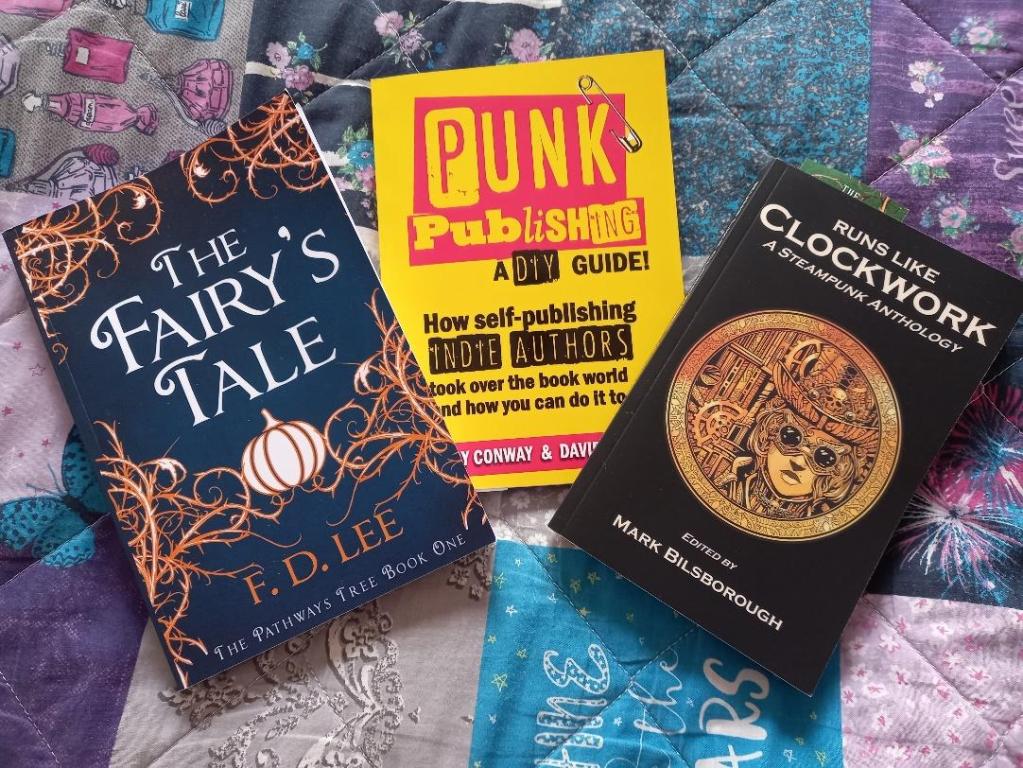
Small Press & Indie Author Books. Photo: Siobhan Logan
For aspiring authors, there were panels on aspects of writing craft from The Art of the Edit to The How & When of Intimate Scenes and Pros & Cons of Writing Groups. And for myself, I have come home with a sack of books and list of TBR recommendations. But I’m also fired up to get back to editing, publishing and my own much-neglected near future novel. Above all, we met wonderful, creative people that we hope to see again at other conventions soon enough. Find your people, as F.D. Lee urged us, and cherish them.
 Space Cat Press